Every release is built from source in the XaasIO DevSecOps pipeline and delivered as signed packages for Rocky Linux 9, RHEL 9 and CentOS Stream 9, or as containers for Kubernetes, with an SBOM per release.
XaasIO CMP · Cloud Management Platform
Hybrid Cloud Management, Made Simple
One control plane for private cloud, virtualization, public cloud, Kubernetes, bare metal, networks and storage. On your infrastructure. With XaasIO lifecycle support and production SRE. Available as a 30-day evaluation copy.
XaasIO CMP connects every environment you already run to one role-based access model, one global application catalog with workflows, deep Day-2 automation with Ansible and FinOps on open FOCUS datasets. Every virtual machine, container and bare-metal server gets a 360-degree view: backup, replication, SIEM alerts, automation runs and open ITSM tickets, in one place.
A XaasIO product: the XaasIO CMP engine, Ansible AWX for automation and FOCUS-standard datasets for FinOps, delivered as signed packages with an SBOM per release. Customer-operated, co-managed or fully managed by XaasIO. Runs in your data center, sovereign cloud or air-gapped site. Evaluate it for 30 days in your own environments before you decide.
Architecture
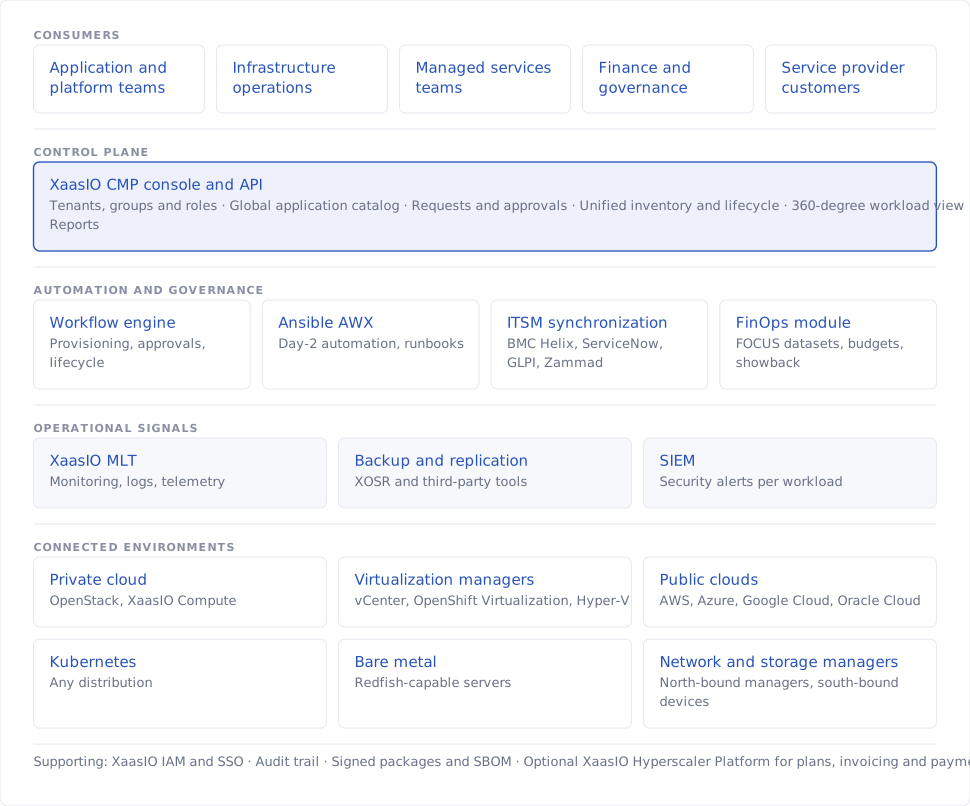
One control plane, every environment, five layers
From the teams that request and operate services down to the clouds, hypervisors, clusters, servers, networks and storage they run on: how one XaasIO platform governs, automates and observes all of it.
ONE CONTROL PLANE, FOUR MODULES
One platform.
Four ways it earns its place.
Enterprises rarely run one environment. The same estate holds a private cloud, two or three hypervisors, several public cloud accounts, a growing number of Kubernetes clusters and racks of bare metal, each with its own console, inventory, access model and way of getting things done. Provisioning takes days, Day-2 work is done by hand, and nobody has one view of a workload.
XaasIO CMP puts one control plane over all of it. Inventory, provisioning and lifecycle follow one RBAC model. A global catalog turns approved services into governed requests. Ansible executes Day-2 work the same way everywhere. FinOps data, normalized to the open FOCUS standard, follows every workload. Each module is useful on its own; together they share one inventory, one identity and one audit trail.
Inventory, provisioning and governance
Unified Cloud Management
- One inventory of virtual machines, containers, bare-metal servers, networks, storage and images across every connected environment, refreshed continuously and searchable by tag, owner and lifecycle state
- Provisioning and lifecycle operations on any target: create, resize, snapshot, migrate, retire, with quotas and approvals
- One role-based access model with tenants, groups and roles mapped to your directory and single sign-on
- Policies for compliance, tagging, placement and retirement, evaluated on events and on schedule, with alerts and automatic correction
- Reports, dashboards and an audit trail of every request, change and automation run
Self-service with workflows
Global Application Catalog and Workflows
- One catalog of approved operating systems, application blueprints,
multi-tier services and infrastructure requests, published per tenant and role
- Requests move through a workflow: cost estimate, approval in your ITSM, provisioning on the selected target, Day-2 configuration, hand-over
- Versioned templates built from images, cloud-init, OpenTofu or Terraform and Ansible content, reusable across environments
- Shopping-cart ordering, service bundles, scheduled retirement and renewal reminders
- The same catalog item can deploy to vSphere, OpenShift Virtualization, OpenStack, a public cloud, a Kubernetes cluster or bare metal
Post-provision, every day after
Deep Day-2 Automation with Ansible
- Ansible AWX runs job templates, workflows and runbooks against the inventory that XaasIO CMP already maintains; no second inventory to keep in sync
- Post-provision OS and middleware configuration, monitoring and logging agents, backup and replication policy, patching, hardening and compliance remediation
- Operational runbooks: service restart and recovery, user and access changes, certificate renewal, scale actions
- Triggered by a catalog request, a schedule, a policy event, an ITSM change or an API call, with approval gates where you want them
- Credentials in a vault, execution environments pinned per release, every run recorded against the workload
Cost visibility and governance
FinOps on Open FOCUS Datasets
- Ingest FOCUS-format billing exports from AWS, Microsoft Azure, Google Cloud and Oracle Cloud, and rate private cloud, virtualization and bare-metal usage with your own cost model
- Normalize everything to the FinOps Open Cost and Usage Specification: billed, effective, list and contracted cost, service category, resource, tags and commitments
- Allocate spend to department, project, service or workload; enforce tagging; produce showback or chargeback
- Budgets with threshold alerts, anomaly detection and forecasts; estimated cost shown before a request is approved
- Dashboards and scheduled reports for stakeholders; datasets exportable to your BI tools
Every module shares the same inventory, identity and audit trail, so a request, an approval, an automation run, a security alert and a cost record all refer to the same workload.
CONNECTED ENVIRONMENTS
Connect what you run today. Add what you run next.
| Environment | Examples | What XaasIO CMP does |
|---|---|---|
| Private cloud | OpenStack, including XaasIO Compute; Red Hat OpenShift Virtualization | Projects, quotas, flavors, images, networks and volumes in inventory; provisioning, lifecycle and retirement; usage rated for FinOps. |
| Virtualization managers | VMware vCenter, Microsoft Hyper-V, Red Hat OpenShift Virtualization, Nutanix, Proxmox, IBM Power | Hosts, clusters, datastores and virtual machines in inventory; provisioning from templates; power, snapshot, reconfigure and migrate operations; right-sizing and retirement. |
| Public cloud | AWS, Microsoft Azure, Google Cloud, Oracle Cloud Infrastructure, IBM Cloud | Accounts, regions, instances, images, networks, storage and key pairs; provisioning through the catalog; FOCUS billing exports ingested for FinOps. |
| Kubernetes | Any distribution: Red Hat OpenShift, XaasIO Managed Kubernetes, Rancher, Amazon EKS, Azure AKS, Google GKE, Oracle OKE, VMware Tanzu | Clusters, namespaces, nodes, pods, services, images and events in inventory; container workloads in the 360-degree view; Day-2 jobs against clusters and nodes. |
| Bare metal | Any server with a Redfish-capable management controller: Dell iDRAC, HPE iLO, Lenovo XClarity, Cisco UCS, Supermicro | Discovery, power and boot control, hardware and firmware inventory; operating system provisioning through PXE and Ansible; servers listed beside virtual machines and containers. |
| Network managers and devices | North-bound: OpenStack Neutron, VMware NSX, cloud virtual networks. South-bound: switches, routers, load balancers and firewalls through their APIs and Ansible network collections | Networks, subnets, security groups, floating IPs and load balancers in inventory; network changes delivered as governed catalog items and runbooks. |
| Storage managers | Ceph and XaasIO Block and Object Storage, OpenStack Cinder and Swift, cloud block and object storage, enterprise arrays through Ansible storage collections | Volumes, snapshots, attachments and object buckets in inventory; storage requests in the catalog; capacity and cost attributed per workload. |
| Automation and configuration managers | Ansible AWX and Ansible Automation Platform, OpenTofu and Terraform, configuration and patch managers | Job templates, workflows, playbooks and plans exposed as catalog actions and Day-2 runbooks; results written back to the workload record. |
Connectors are validated per release. The examples above are the environments most often connected; the current support matrix for each release is published with the release notes.
PLATFORM COMPONENTS
Everything needed to run hybrid cloud as one service
Unified Inventory and Discovery
Continuous discovery of virtual machines, containers, hosts, clusters, bare-metal servers, networks, volumes, images and their relationships across every provider, with tags, owners and lifecycle state.
Provider connectors · Event-driven refresh · Relationship graph · Tagging and search
Orchestration and Provisioning Engine
Provisioning workflows that pick the target, apply placement and naming rules, request approval, create the resource, configure it and hand it over, with retries, rollback and full state history.
Workflow engine · Placement and naming policies · OpenTofu and Terraform · cloud-init · Retirement workflows
RBAC, Tenancy and Policy
Tenants, groups and roles with fine-grained product features, scoped to the environments, tags and catalog items each team may see or act on. Policies check compliance, tagging and configuration and can alert, block or correct.
XaasIO IAM · SAML, OIDC, LDAP and Active Directory · Role and tag scoping · Policy engine · Audit trail
Global Application Catalog
Approved operating systems, application blueprints and multi-tier services published once and offered to every tenant with the right role, with cost estimates, approvals and versioned templates.
Service catalog · Blueprints and bundles · ITSM approval hand-off · Cost estimate before ordering
Day-2 Automation Engine
Ansible AWX job templates, workflows, schedules and event-driven triggers against the live inventory, with credential management, execution environments, approval gates and per-workload run history.
Ansible AWX · Ansible Automation Platform option · Execution environments · Credential vault · Webhooks and events
FinOps and Reporting
FOCUS-format cost and usage datasets from public clouds and rated private infrastructure, allocated by tag, project and department, with budgets, anomaly detection, forecasts, showback and scheduled reports.
FOCUS datasets · Cloud billing exports · Rate cards · Budgets and anomalies · BI export
ACCESS METHODS
Consume the platform the way your teams already work
End users order from a catalog. Operators use the console. Platform teams automate through the API, Ansible and infrastructure as code. Requests can start in your ITSM portal. The same identity, policy and audit trail apply to all of them.
Console
Console
Self-service catalog
OpenAI-compatible API
REST API
SDKs and playground
Ansible and AWX
JupyterHub and VS Code
OpenTofu and Terraform
Slurm CLI
ITSM portals
Kubeflow and Kubernetes
Webhooks and events
GitOps and infrastructure as code
HOW IT WORKS
One request. From catalog to governed, observed workload.
01
Request
A user selects an operating system, application blueprint or infrastructure service from the catalog. XaasIO CMP shows the estimated cost and validates quota and policy.
02
Approve
The request is routed to your ITSM for approval and change control. Status flows back to the requester; nothing is built without an approval record.
03
Provision
The workflow places the workload on the selected target: private cloud, hypervisor, public cloud, Kubernetes cluster or bare metal, with naming, network and storage rules applied.
04
Automate
Ansible performs Day-2 tasks orchestrated from XaasIO CMP: OS and application configuration, agents, backup and replication policy, hardening and compliance.
05
Operate
Monitoring, logging, telemetry, backup, replication, SIEM, ITSM and FinOps context are attached to the workload. Its 360-degree view stays current until retirement.
Users request a service. XaasIO CMP manages the policy, approval, target environment, workflow state and execution context. Ansible executes. Every signal about the result is attached to the workload record.
360-DEGREE VISIBILITY
One record for every workload, in any environment
For every virtual machine, container and bare-metal server, XaasIO CMP shows the platform and location, the applications and services connected to it, its monitoring, logging and telemetry status, backup and replication state, open SIEM alerts, automation workflows and their results, open ITSM tickets and change records, compliance and policy status, lifecycle state and cost against budget. Operations teams stop switching between ten consoles to answer one question.
erp-app-02
Virtual machine · OpenShift Virtualization · Mumbai DC-1 · Owner: Finance Applications · Environment: Production
Platform and location
OpenShift Virtualization, cluster ocpv-prod-01
8 vCPU · 32 GB · 3 disks · VLAN 210 · Zone A
Connected services
4 services, 2 dependencies
PostgreSQL (XaasIO RDS) · Object bucket · Load balancer · Message queue
Monitoring
Healthy, 1 warning in 7 days
XaasIO MLT · CPU 41% · Memory 63% · SLA 99.97%
Logs and telemetry
Ingesting
Fluentd agent v1.17 · 2.1 GB per day · Traces enabled
Backup
Last successful 02:10 today
Policy: Gold, daily, 35-day retention · Verified restore 12 days ago
Replication
In sync, RPO 15 min
XOSR to Chennai DC-2 · Last failover test: passed
SIEM alerts
1 open, medium
Repeated failed SSH logins · Ticket INC0048213 linked
Automation workflows
Last run: patching, succeeded
Ansible AWX · 14 runs in 30 days · Next: certificate renewal, Fri 22:00
ITSM tickets
1 incident open, 1 change scheduled
BMC Helix ITSM · CHG0031177 approved for Sat 01:00 · CMDB CI in sync
Compliance and policy
Compliant
Hardening profile applied · Tags complete · No drift
Lifecycle
Production since Jan 2026
Provisioned from catalog item ERP Application Server v3 · Review due Dec 2026
Cost and budget
$412 month to date, 68% of budget
FinOps: Finance Applications, project ERP · Forecast: within budget
Illustrative record. Values, sources and tile layout depend on the connected tools and the release. Where a signal is not connected, the tile shows the source that would provide it.
ITSM SYNCHRONIZATION
Automation that respects your service management process
XaasIO CMP does not replace the ITSM you already run. It synchronizes with it, so approval, CMDB, incident and change-management processes keep working while provisioning and Day-2 operations become automatic.
Approval-based provisioning
Incident creation from the console
Change request workflows
Bidirectional ticket and status updates
CMDB and asset synchronization
Governed deprovisioning
BMC Helix ITSM
Approval-based provisioning, incident creation, change requests and bidirectional status updates. In production at a leading financial services major; see the customer story below.
ServiceNow
Catalog requests raised in ServiceNow or in XaasIO CMP, approvals, incidents, change requests and CMDB configuration items kept in sync.
GLPI
Open-source ITSM and asset management: tickets, changes, approvals and asset records synchronized for organizations that standardize on open tools.
Zammad
Open-source helpdesk and ticketing: tickets opened from workload events and automation results, with status flowing back to the workload record.
Other ITSM, CMDB and ticketing tools connect through the REST API and webhooks. Synchronization scope is configured per tool and per tenant.
DAY-2 AUTOMATION
Deep Day-2 automation with Ansible, orchestrated from one place
Ansible is the Day-2 execution engine; XaasIO CMP is the orchestration and governance layer. The control plane owns the request, the policy, the approval, the target environment, the workflow state and the execution context. Ansible AWX runs the job against the inventory XaasIO CMP already maintains, and the result is written back to the workload record. The standard library covers:
Post-provision OS configuration
Application and middleware configuration
Monitoring agent installation
Logging and telemetry onboarding
Backup policy configuration
Replication policy configuration
Patch management
Security hardening
Compliance remediation
Operational runbooks
Service restart and recovery workflows
User, access and configuration changes
Job templates, workflows and schedules run the same way on private cloud, virtualization, public cloud, Kubernetes and bare-metal workloads. Organizations that already own Red Hat Ansible Automation Platform connect it in place of AWX.
FINOPS
Cost visibility on the open FOCUS standard
FOCUS, the FinOps Open Cost and Usage Specification maintained by the FinOps Foundation, defines one schema for cost and usage data. AWS, Microsoft Azure, Google Cloud and Oracle Cloud publish billing exports in it. XaasIO CMP ingests those exports, rates private infrastructure in the same schema and gives finance, operations and application teams one set of numbers.
Provisioning is no longer only an operational decision. Every catalog request shows its estimated cost, and every workload carries its cost, budget and forecast in its 360-degree view.
Sources
Public cloud FOCUS exports
AWS, Azure, Google Cloud, Oracle Cloud
Private infrastructure usage
XaasIO Compute, virtualization, Kubernetes, bare metal, storage
Rate cards and contracts
Your cost model for owned capacity
Normalize
FOCUS columns
BilledCost, EffectiveCost, ListCost, ContractedCost, ChargeCategory, ServiceCategory, ResourceId, Tags, commitment discounts
Allocate
Department, project, service, workload
Tagging governance
Showback or chargeback
Govern
Budgets and threshold alerts
Anomaly detection
Forecasts
Cost estimate before approval
Outputs
Dashboards and scheduled reports
FOCUS datasets for BI tools
Invoices and payments
Optional, through XaasIO Hyperscaler Platform
Showback, budgets and reports are part of XaasIO CMP. Rating plans, invoicing, payments and reseller settlement for service providers are delivered by the XaasIO Hyperscaler Platform.
PLANNING TOOL
Estimate the hours automation returns
Manual provisioning and Day-2 work are measured in engineer hours. Enter your monthly request and task volumes and the time each takes today to see how many hours governed self-service and Ansible automation can return each month, and what that is worth at a rate you choose.
Operations effort estimator
Hours returned per month 1,296
Full-time equivalents 8.1
Monthly cost avoided Set a rate
Planning estimate only. It assumes an automated request or task still takes a fraction of the manual time (one tenth) for review and approval, and 160 working hours per full-time equivalent. Your volumes, task mix and change-management rules decide the real figure; a XaasIO assessment produces a validated baseline.
DEPLOYMENT MODELS
Choose the deployment that fits your estate
Enterprise Hybrid Cloud Control Plane
One console, catalog and RBAC model over private cloud, hypervisors, public cloud accounts, Kubernetes and bare metal, with ITSM synchronization, Day-2 automation and FinOps showback.
Service Provider Multi-Tenant CMP
Tenant-isolated catalogs, automation and reporting for managed service providers, with plans, invoicing and payments through the XaasIO Hyperscaler Platform.
Sovereign and Air-Gapped
The complete control plane, automation engine, content and documentation inside the boundary, with local identity, signed offline updates and no dependency on a public service.
VMware Exit and Migration Control
Manage the existing vSphere estate and the target XaasIO Compute or OpenShift Virtualization platform from one place while workloads move, with migration waves, validation and cut-over runbooks.
WHAT IS INCLUDED
One platform. Optional XaasIO modules around it.
XaasIO CMP is a complete product on its own and manages environments from any vendor. Other XaasIO platforms are optional: they add signals to the 360-degree view, become additional targets, or turn the control plane into a billable cloud service.
XaasIO CMP
Included: console and API, unified inventory, RBAC and tenancy, global application catalog and workflows, Ansible AWX, ITSM synchronization, FinOps module, 360-degree view, connectors for the listed environments. A 30-day evaluation copy is available.
XaasIO MLT
Optional, recommended: monitoring, logging and telemetry for every connected workload, feeding the monitoring, logs and SLA tiles of the 360-degree view.
XaasIO Compute, Storage, Kubernetes, RDS and XOSR
Optional targets and signals: OpenStack private cloud, Ceph storage, managed Kubernetes, managed databases and XOSR replication, managed through the same control plane.
XaasIO Hyperscaler Platform
Optional, for service providers and IT-as-a-service: a hyperscaler-style self-service experience with plans, rating, invoicing, payments and reseller settlement across XaasIO modules.
OPERATING MODEL
Hybrid cloud management without the integration burden
XaasIO designs, deploys, validates and supports XaasIO CMP as one production platform rather than a collection of separate consoles, connectors, playbooks and scripts.
Validated Architecture
Control plane, database, workers, automation engine, connectors, identity and reporting sized and tested as one architecture, in high availability where required.
Controlled Lifecycle
Documented release, patching, upgrade, compatibility, rollback and maintenance procedures for the platform, its connectors and every pinned component.
Secure and Sovereign
Flexible Operating Model
Customer-operated, co-managed, fully managed, or a dedicated XaasIO SRE Pod.
TOWARD GOVERNED AUTONOMY
From automated operations to closed-loop, governed autonomy
With XaasIO MLT, XaasIO AI Lake and XaasIO AI-SRE, AI agents work with XaasIO CMP, FinOps data, your ITSM and Ansible to move infrastructure operations from reactive administration toward policy-governed, closed-loop operations, with approval and audit trails in your ITSM at every step.
AI-assisted incident analysis
AI-driven root cause analysis
Automated remediation recommendations
Ansible remediation orchestrated from XaasIO CMP
Cost-aware decisions on FinOps data
Policy-governed autonomous operations
ITSM-controlled approvals and audit trails
Closed-loop monitoring, action, validation and reporting
Delivered in phases with the XaasIO MLT AI-Native extension and XaasIO AI-SRE. Availability by release.
CUSTOMER STORY . FINANCIAL SERVICES
A leading financial services major: unified hybrid cloud management, automated provisioning, Day-2 automation and FinOps
A leading financial services major ran workloads across Red Hat OpenShift Virtualization, Microsoft Hyper-V, VMware, Microsoft Azure, AWS and bare metal, each with its own tools, inventory and processes. Application and VM provisioning were manual tasks for the managed services team, there was no unified self-service catalog, Day-2 work was not standardized and no single view existed for a workload's monitoring, backup, replication, SIEM, ITSM and cost context. Any automation had to work inside the existing BMC Helix ITSM approval, CMDB, incident and change processes.
Solution
XaasIO CMP
Unified hybrid cloud control plane: inventory, catalog, approvals, orchestration, lifecycle
XaasIO MLT
Observability, logging, telemetry, SLA monitoring
XaasIO FinOps module
Cost visibility, budgets, anomaly detection, forecasting
BMC Helix ITSM and Ansible
Approval-based provisioning and Day-2 automation
Results
- Automated provisioning with ITSM approval. Users select services from a unified application and OS catalog; requests route through BMC Helix ITSM and provision automatically after approval.
- Unified inventory and management across OpenShift Virtualization, Hyper-V, VMware, Azure, AWS and bare metal from one control plane.
- 360-degree infrastructure insight for every VM, cloud instance and physical server: platform, integrations, monitoring, logs, backup, replication, SIEM incidents, tickets, change records, lifecycle, compliance and cost.
- Standardized Day-2 operations with Ansible orchestrated from XaasIO CMP across private cloud, public cloud and bare metal.
- FinOps-driven cost governance: budgets, anomaly detection, tagging policies and optimization opportunities across managed environments.
Next phase
AI agents on Red Hat OpenShift AI
Working with XaasIO CMP, MLT, FinOps, BMC Helix ITSM, SIEM data and Ansible toward closed-loop, governed autonomy
Advanced Cloud Management Support Packs
VMware Exit Control Pack
Wave planning, migration runbooks and validation to XaasIO Compute or OpenShift Virtualization
Virtualization Onboarding Pack
Hyper-V, OpenShift Virtualization, Nutanix and Proxmox connectors, policies and catalog items
Public Cloud Landing Zones
AWS, Azure, Google Cloud and Oracle Cloud accounts, guardrails, tagging and FOCUS billing ingestion
ITSM Integration Pack
BMC Helix, ServiceNow, GLPI or Zammad approval, incident, change and CMDB synchronization
FinOps Enablement Pack
Cost data ingestion, dashboards, budgets, forecasting, anomaly detection, tagging governance and reporting
Day-2 Automation Library
Curated Ansible content for the twelve standard Day-2 use cases, adapted to your standards
CMP VS HYPERSCALER PLATFORM
XaasIO CMP or XaasIO Hyperscaler Platform? Different jobs. They work together.
| Dimension | XaasIO CMP | XaasIO Hyperscaler Platform |
|---|---|---|
| Primary purpose | Govern, provision, automate and observe workloads across every environment you already run | Deliver a hyperscaler-style self-service cloud on XaasIO platforms, with plans and billing |
| Main users | Infrastructure operations, managed services, application teams, finance and governance | Cloud consumers and tenants; service provider product, billing and support teams |
| What it manages | Private cloud, virtualization managers, public clouds, Kubernetes, bare metal, network and storage managers from any vendor | XaasIO Compute, Block and Object Storage, Managed Kubernetes, RDS, AI Factory, AI Lake, MLT and other XaasIO modules |
| Catalog | Global application and OS catalog with approval workflows and cost estimates | Service catalog with plans, quotas, regions and prices |
| Automation | Day-2 automation with Ansible AWX, workflows, policies and event-driven triggers | Provisioning of XaasIO services through their APIs |
| Governance | RBAC with tenants, groups and roles; policies; ITSM approvals, incidents and changes | Tenants, projects, IAM, quotas and usage limits |
| Cost | FinOps on FOCUS datasets: allocation, budgets, anomalies, forecasts, showback and chargeback | Metering, rating, invoicing, payments and reseller settlement |
| ITSM | BMC Helix, ServiceNow, GLPI and Zammad synchronization; others through the API | Support tickets in the console; ITSM processes through XaasIO CMP or the API |
| 360-degree workload view | Yes: platform, services, monitoring, logs, backup, replication, SIEM, automation, tickets, compliance and cost | Service, usage and billing views per tenant |
| Typical buyer | CIO, head of infrastructure, cloud platform owner, managed service provider operations | Service provider business owner, enterprise IT-as-a-service leader |
| Can operate independently | Yes; manages any estate with no other XaasIO module | Yes; delivers XaasIO services without XaasIO CMP |
| Together | Operates and automates everything, including non-XaasIO environments, and feeds usage to the platform | Publishes, rates and bills services; XaasIO CMP governs and automates what runs behind them |
KEY TERMS
Glossary
Cloud management terms used on this page.
Cloud management platform (CMP)
Software that provides inventory, self-service provisioning, governance, automation and cost management across clouds, hypervisors, clusters and servers from one control plane.
Control plane
The layer that decides and coordinates: policy, approval, placement, workflow state and audit. Workloads themselves run in the data plane of each connected environment.
Day-2 automation
Everything done to a workload after it is provisioned: configuration, agents, patching, hardening, compliance, runbooks and changes. On this page, Ansible executes it and XaasIO CMP orchestrates it.
Ansible AWX
The open-source upstream of the Red Hat Ansible Automation Platform controller: job templates, workflows, schedules, credentials and inventories with a web interface and API.
FOCUS
The FinOps Open Cost and Usage Specification: an open schema for cost and usage data maintained by the FinOps Foundation and published as billing exports by the major public clouds.
Redfish
The DMTF standard API for managing servers out of band through their management controllers: power, boot order, hardware inventory, firmware and health.
RBAC
Role-based access control: what a tenant, group or role may see and do, scoped by environment, tag and catalog item, mapped to your directory and single sign-on.
ITSM and CMDB
IT service management (approvals, incidents, changes) and the configuration management database that records assets. XaasIO CMP synchronizes with both rather than replacing them.
Showback and chargeback
Reporting cost to the teams that consume it (showback) or invoicing them for it (chargeback), both allocated from FOCUS-normalized cost and usage data.
Frequently asked questions
What is XaasIO CMP?
XaasIO CMP is a cloud management platform: one control plane that connects private cloud, virtualization managers, public clouds, Kubernetes distributions, bare-metal servers, network managers and storage managers, and provides a single role-based access model, a global application catalog with workflows, Day-2 automation with Ansible, synchronization with your ITSM and FinOps on open FOCUS datasets. Every virtual machine, container and bare-metal server gets a 360-degree view of its monitoring, backup, replication, SIEM alerts, automation runs and open tickets. XaasIO designs, validates, supports and can operate it.
Which environments can XaasIO CMP manage?
OpenStack and XaasIO Compute private clouds; VMware vCenter, Microsoft Hyper-V, Red Hat OpenShift Virtualization, Nutanix, Proxmox and IBM Power virtualization; AWS, Microsoft Azure, Google Cloud, Oracle Cloud Infrastructure and IBM Cloud; any Kubernetes distribution; any bare-metal server with a Redfish-capable management controller; and network and storage managers through their APIs and Ansible collections. Connectors are validated per release, and the support matrix is published with each release.
How is XaasIO CMP licensed, and can we evaluate it first?
XaasIO CMP is a commercial XaasIO product licensed under a XaasIO agreement that covers the software, updates, connectors and support. A 30-day evaluation copy is available on request, so your team can connect its own environments, run the catalog and Ansible workflows, synchronize a test ITSM instance and see the 360-degree view before a decision. XaasIO builds every release from source in its DevSecOps pipeline, signs the packages and publishes a software bill of materials. Ansible AWX and the FOCUS specification, which the platform uses, are open projects maintained by their own communities.
How does XaasIO CMP compare with HPE Morpheus, VMware Aria Automation or IBM Cloud Paks?
XaasIO CMP belongs to the same category as HPE Morpheus and VMware Aria Automation: a hybrid cloud management platform with self-service, orchestration, governance, automation and cost management. Like IBM Cloud Paks, it packages several capabilities as one pre-integrated, supported product. The differences are deployment on your own infrastructure including air-gapped sites, connectors for any Kubernetes distribution and any Redfish-capable server, Day-2 automation on Ansible, FinOps on the open FOCUS standard, ITSM synchronization that includes GLPI and Zammad, a 30-day evaluation copy, and XaasIO operating options. Feature-by-feature comparisons are available from XaasIO on request.
Does XaasIO CMP replace our ITSM?
No. It synchronizes with it. Catalog requests are approved in your ITSM, incidents can be raised from the XaasIO CMP console, changes follow your change-management workflow, ticket status flows back to the workload record and CMDB configuration items stay in sync. Enterprise governance stays where your auditors expect it.
Which ITSM tools are supported?
BMC Helix ITSM, ServiceNow, GLPI and Zammad, with approval-based provisioning, incident creation, change request workflows, bidirectional ticket and status updates and CMDB or asset synchronization. Other ITSM, CMDB and ticketing tools connect through the REST API and webhooks.
What is in the 360-degree view, and where do the signals come from?
For every virtual machine, container and bare-metal server: platform and location, connected applications and services, monitoring status, logs and telemetry, backup status, replication status, SIEM alerts, automation workflows and results, open ITSM tickets and change records, compliance and policy status, lifecycle state and cost against budget. Monitoring, logs and telemetry come from XaasIO MLT or your existing tools; backup and replication status from XOSR or your backup and replication products; SIEM alerts from your SIEM; tickets from your ITSM; and cost from the FinOps module.
Do we need Red Hat Ansible Automation Platform?
No. XaasIO CMP includes Ansible AWX, the open-source upstream of the Ansible Automation Platform controller, with execution environments, credentials and inventories managed for you. Organizations that already own Ansible Automation Platform connect it in place of AWX and keep their existing content and support.
What is FOCUS, and why does XaasIO CMP use it?
FOCUS is the FinOps Open Cost and Usage Specification maintained by the FinOps Foundation: one schema for cost and usage data with columns such as billed, effective, list and contracted cost, charge and service category, resource identifiers, tags and commitment discounts. AWS, Microsoft Azure, Google Cloud and Oracle Cloud publish billing exports in it. Using FOCUS means one cost model for all clouds, no proprietary cost schema to maintain, and datasets that your BI tools and auditors can read directly.
Can XaasIO CMP show private cloud and public cloud costs together?
Yes. Public cloud costs arrive as FOCUS exports. Private cloud, virtualization, Kubernetes and bare-metal usage is metered by the platform and rated with your own cost model, then expressed in the same FOCUS columns. Departments, projects and workloads therefore see one number across environments, with budgets, anomaly detection, forecasts and a cost estimate before every request is approved.
Can it provision bare-metal servers?
Yes. Any server with a Redfish-capable management controller is discovered with its hardware and firmware inventory and controlled for power and boot order. Operating systems are provisioned through PXE and Ansible, and the server then appears in the same inventory, catalog, automation and 360-degree view as virtual machines and containers.
How does XaasIO CMP handle Kubernetes?
Any Kubernetes distribution connects as a container provider. Clusters, namespaces, nodes, pods, services, images and events appear in the inventory, container workloads get the 360-degree view, catalog items can deploy to clusters and Ansible jobs can target clusters and nodes. XaasIO CMP manages Kubernetes alongside everything else; it does not replace the Kubernetes control plane or GitOps tooling that platform teams use inside a cluster.
How is access controlled?
Through one role-based access model: tenants, groups and roles mapped to your directory through SAML, OpenID Connect, LDAP or Active Directory, with product features, environments, tags and catalog items scoped per role. Every request, approval, change and automation run is recorded in the audit trail.
Can XaasIO CMP run in an air-gapped environment?
Yes. The control plane, automation engine, Ansible content, connectors and documentation run inside the boundary with local identity and signed offline updates. Public cloud connectors and FOCUS ingestion are used only where the site has an approved path to those clouds.
Do we need the XaasIO Hyperscaler Platform?
No. XaasIO CMP is complete on its own for enterprise hybrid cloud management, with showback and budgets included. Add the XaasIO Hyperscaler Platform when you want to sell services: a hyperscaler-style self-service experience with plans, rating, invoicing, payments and reseller settlement across XaasIO modules.
Can XaasIO CMP help with a VMware exit?
Yes. It manages the existing vSphere estate and the target platform, XaasIO Compute on OpenStack or Red Hat OpenShift Virtualization, from one console while workloads move. Migration waves, validation and cut-over runbooks run as governed workflows, and the VMware Exit Control Pack provides the assessment and migration services around them.
Who operates XaasIO CMP?
You choose: customer-operated with XaasIO support, co-managed, fully managed by XaasIO, or a dedicated XaasIO SRE Pod. Every deployment includes a validated architecture, a documented release and upgrade policy, an SBOM per release and 24x7 support options.
VMware, vSphere, vCenter, Microsoft, Hyper-V, Azure, Red Hat, OpenShift, Ansible, Amazon Web Services, AWS, Google Cloud, Oracle, IBM, Nutanix, Proxmox, Kubernetes, Redfish, BMC, Helix, ServiceNow, GLPI, Zammad, HPE, Morpheus, FinOps Foundation, FOCUS and other product names are trademarks of their respective owners and are named for identification and comparison only. XaasIO is not affiliated with, endorsed by or sponsored by these organizations.
Build what the world depends on.
Planning a cloud for government, financial services, pharmaceuticals, healthcare, energy, transport, industry, service-provider operations, or private AI? Work with XaasIO to define the architecture, security boundary, and operating model your environment requires.