Encrypt connections with TLS, control network exposure, limit actions by role and namespace, and sign in through your identity provider.
Technical reference: TLS · RBAC · OIDC · Load Balancer and NodePort Policies
Built on OpenEverest, a CNCF Sandbox project. Upstream-aligned. Customer-operated, co-managed or fully managed by XaasIO.
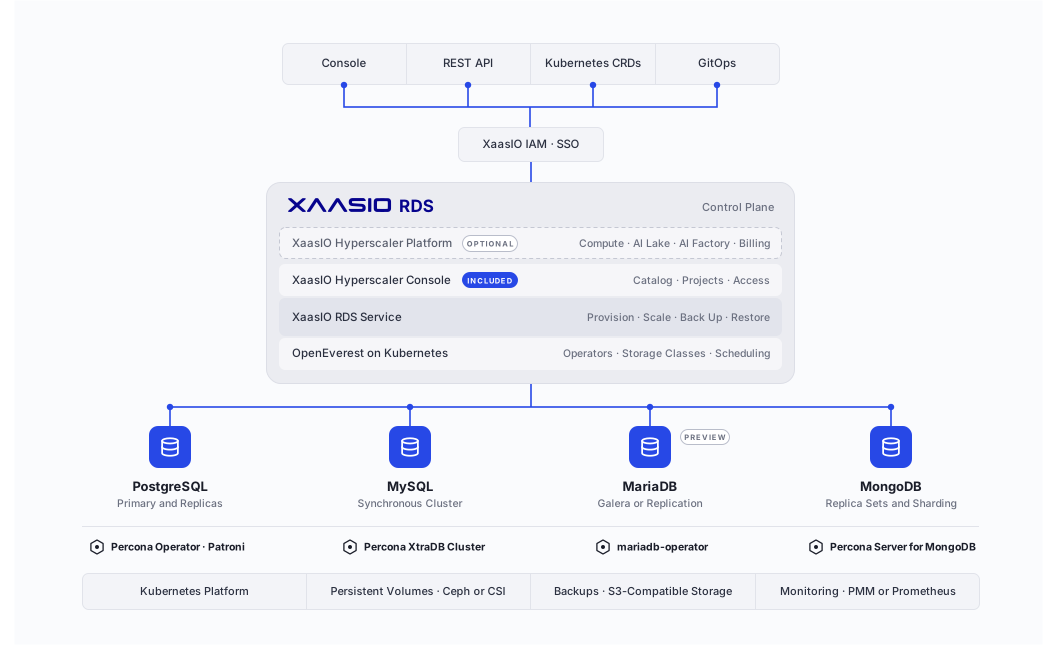
Database Engines | Launch PostgreSQL, MySQL, MariaDB and MongoDB from approved versions and service profiles. Start with a single node for development or a highly available cluster for production. Technical reference: OpenEverest · Percona Operators · mariadb-operator |
Availability and Scaling | Run replicas with operator-managed failover. Add nodes, resize CPU and memory, and expand storage as workloads grow. Technical reference: Patroni · Galera · Replica Sets · Sharding |
Backup and Recovery | Schedule backups to S3-compatible object storage, restore in place or into a new database, and recover to a point in time on supported engines. Technical reference: pgBackRest · XtraBackup · mariadb-backup · Percona Backup for MongoDB |
Identity and Governance | Separate teams, customers, and environments using namespaces, roles, and policies. Integrate enterprise single sign-on and map identity provider groups to roles. Technical reference: RBAC · OIDC · Namespaces · TLS |
Use the same service through the:
The default choice for new transactional applications, with a rich extension ecosystem and strong SQL standards support.
Streaming replication with automatic failover managed by Patroni.
For web, commerce and SaaS applications that depend on MySQL compatibility and need every node to hold the same data.
Synchronous replication across every node. The cluster stays available while a majority of nodes is healthy.
For applications built on MariaDB and teams standardizing on Galera clustering.
Galera synchronous cluster shown. Standalone and asynchronous primary and replica topologies are also available.
For document data such as catalogs, content, profiles and event streams that benefit from a flexible schema.
Replica-set elections provide automatic failover.
Add shards to scale out horizontally.
Offer single-node, three-node and larger topologies as simple choices. Operators manage replication, failover and recovery for each engine.
Technical reference: Patroni · Galera · Replica Sets · Sharding
Schedule backups with retention, run them on demand, restore in place or into a new database, and recover to a point in time on supported engines.
Technical reference: pgBackRest · XtraBackup · Percona Backup for MongoDB · S3-Compatible Storage
Add or remove nodes, resize CPU and memory, expand volumes, pause idle databases and tune engine parameters. Scheduling policies keep replicas on separate hosts or zones.
Technical reference: Horizontal and Vertical Scaling · Storage Expansion · Pod Scheduling Policies
Encrypt connections with TLS, control network exposure, limit actions by role and namespace, and sign in through your identity provider.
Technical reference: TLS · RBAC · OIDC · Load Balancer and NodePort Policies
Send metrics and query analytics to Percona Monitoring and Management, or expose Prometheus-compatible metrics to your existing observability stack.
Technical reference: PMM · Prometheus · Query Analytics
Create new databases from existing backups, and import external backups to move self-managed or cloud-hosted databases onto the service.
Technical reference: Data Importers · Restore to New Database
Advanced capabilities depend on the engine and on the validated Kubernetes, storage, and OpenEverest architecture selected for each deployment.
XaasIO designs, deploys, validates and supports XaasIO RDS as one production service rather than an unsupported collection of operators, charts and scripts.
Kubernetes, operators, storage classes, backup targets, identity and monitoring are tested as a complete solution.
Engine versions, operators and the control plane follow a documented release, patching and upgrade policy based on validated upstream releases.
Operate with local image registries, identity, object storage, monitoring and controlled update procedures inside the approved security boundary.
Choose customer-operated, co-managed, fully managed or dedicated SRE Pod operations.
Built for enterprise private cloud, sovereign and regulated cloud, and cloud service provider or MSP environments.
Frequently asked questions
XaasIO RDS is a managed database service for PostgreSQL, MySQL, MariaDB and MongoDB that runs on Kubernetes in your own data center, sovereign cloud or service provider environment. It provides self-service provisioning, high availability, backups and recovery through a console, a REST API and Kubernetes custom resources.
XaasIO RDS supports PostgreSQL, MySQL, MariaDB and MongoDB. PostgreSQL, MySQL and MongoDB run on the stable OpenEverest release line. MariaDB is delivered through the OpenEverest v2 provider architecture and is offered as a Technology Preview until the validated XaasIO release is announced.
Yes. XaasIO RDS is built on OpenEverest, an Apache 2.0 licensed CNCF Sandbox project for provisioning and managing databases on Kubernetes. XaasIO adds a validated architecture, lifecycle management, the XaasIO Hyperscaler console and support.
No. MongoDB is a document database. XaasIO RDS delivers it alongside the relational engines so that teams manage both through the same console, policies and operating model.
XaasIO RDS provides a comparable self-service managed database experience on infrastructure you control. It is not API-compatible with Amazon RDS. Applications connect with standard PostgreSQL, MySQL, MariaDB and MongoDB drivers, and provider-specific features such as proprietary extensions or IAM database authentication are reviewed during migration planning.
Yes. Production clusters run multiple nodes with operator-managed failover, and scheduled or on-demand backups are stored in S3-compatible object storage. Point-in-time recovery is available for PostgreSQL, MySQL and MongoDB. For MariaDB it follows the upstream provider roadmap.
XaasIO RDS runs on XaasIO Managed Kubernetes or on a validated Kubernetes platform in your data center, colocation facility or cloud account. Database volumes use your Kubernetes storage classes, such as Ceph, and backups use S3-compatible object storage.
Yes. XaasIO RDS can be designed with local image registries, identity, object storage, monitoring and controlled update procedures for disconnected, sovereign and restricted environments.
Yes. The default XaasIO RDS edition includes the XaasIO Hyperscaler console for database self-service. Extending the console to other XaasIO modules, such as XaasIO Compute or XaasIO AI Lake, requires the XaasIO Hyperscaler Platform.
No. XaasIO RDS can operate independently. XaasIO Compute, XaasIO AI Lake, XaasIO AI Factory and the other XaasIO modules are optional and are delivered through the XaasIO Hyperscaler Platform.
You choose the operating model. XaasIO RDS can be customer-operated, co-managed, fully managed by XaasIO or run by a dedicated SRE Pod.
PostgreSQL, MySQL, MariaDB, MongoDB, MongoDB Atlas, Percona, Kubernetes, OpenEverest, Amazon RDS, Amazon Aurora, Microsoft Azure and Google Cloud SQL are trademarks of their respective owners and are named for identification only. XaasIO is not affiliated with, endorsed by or sponsored by these organizations.
We use cookies and similar technologies to improve your experience on our website.