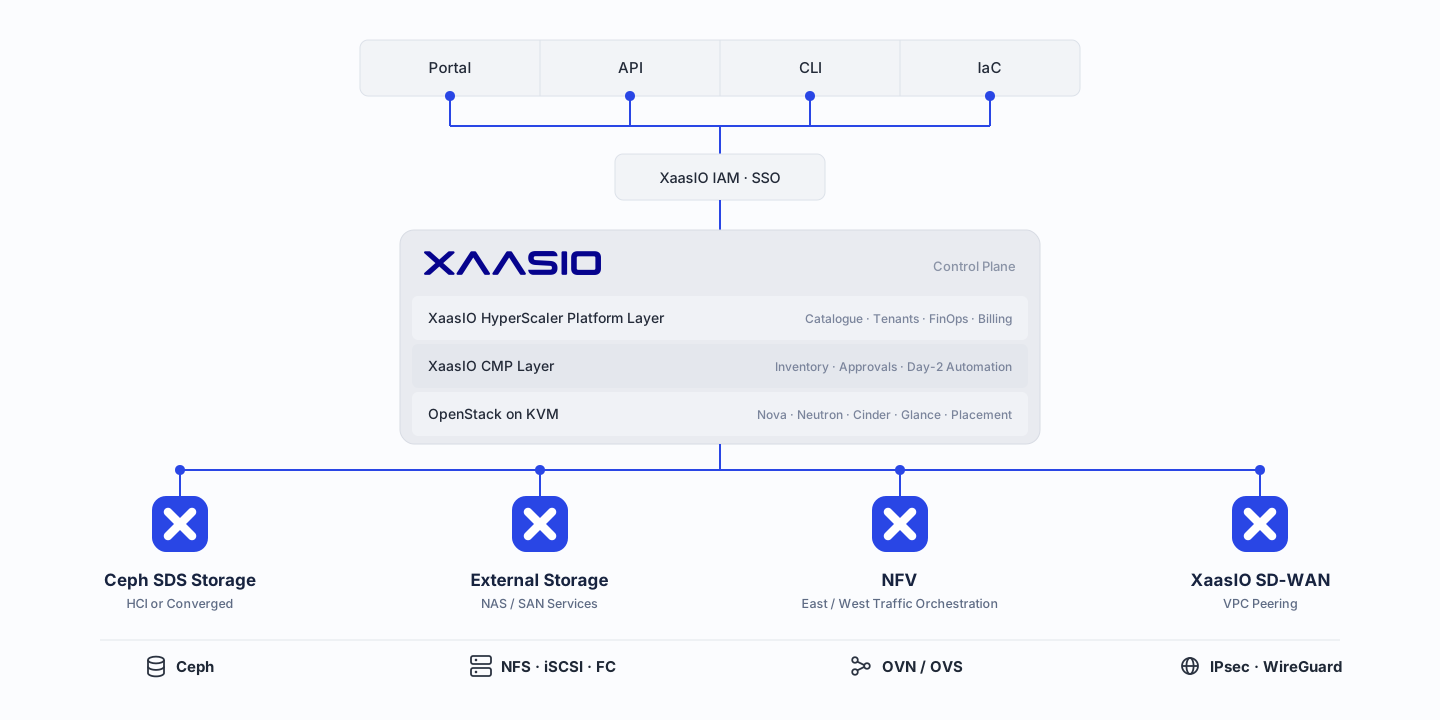
OPENSTACK PRIVATE CLOUD

OpenStack Private Cloud,
Made Simple

Give teams self-service access to virtual machines, networks and persistent storage through one cloud experience. Add GPU or bare-metal capacity when required, while retaining control of your infrastructure, identity, data and operations.

OpenStack by default. Upstream-aligned. Customer-operated, co-managed or fully managed by XaasIO.

OPENSTACK, SIMPLIFIED

Everything Needed to Deliver Infrastructure as a Cloud

Users select the infrastructure service they need. OpenStack coordinates identity,
placement, compute, networking, and storage behind the scenes.


Main components

Compute

Launch Windows and Linux virtual machines from approved images and service profiles. Add GPU-backed instances or bare-metal servers when included in the architecture.

Technical reference: Nova · Glance · Placement

Networking

Create isolated networks, subnets, routers, public IP addresses, security rules and load balancers without manually configuring every infrastructure request.

Technical reference: Neutron · Octavia
Storage

Attach persistent volumes, select storage tiers, create snapshots and use Ceph or supported enterprise storage platforms.

Technical reference: Cinder
Identity and Governance

Separate departments, customers and environments using projects, roles, policies and quotas. Integrate enterprise identity where required.

Technical reference: Keystone 

Use the same cloud through the portal, API, CLI, or infrastructure as code.


HOW IT WORKS

One Request. OpenStack Coordinates Everything.

01

Choose

Select an approved image, compute profile, network and storage option.
02

Validate

OpenStack confirms identity, permissions, policies and available quota.
03

Place

OpenStack identifies compatible capacity based on resources, location and hardware requirements.
04

Deliver

OpenStack creates the workload, connects its network, attaches storage and returns the completed service.

Users request a cloud service. OpenStack handles the infrastructure coordination.


ADVANCED CAPABILITIES

Powerful Infrastructure, Presented as Simple Choices

Smart Workload Placement

Offer general-purpose, memory-optimized, compute-intensive, SSD-backed, GPU-enabled and dedicated-CPU profiles. OpenStack maps each profile to compatible infrastructure.

Technical reference: Flavors · Placement · Traits · Host Aggregates

Software-Defined Networking

Provide private and external networks, VLAN and overlay connectivity, virtual routing, floating IP addresses, security groups, quality of service and load balancing.

Technical reference: Neutron · Octavia

High-Performance Compute

Support dedicated CPUs, NUMA-aware placement, huge pages, SR-IOV, PCI passthrough, GPUs, vGPUs and bare-metal servers when included in the validated architecture.

Technical reference: Nova · Placement · Ironic

Maintenance, Recovery and Scale

Move compatible workloads during maintenance, recover instances after host failures and organize capacity across availability zones, cells, regions and infrastructure classes.

Technical reference: Live Migration · Evacuation · Cells · Availability Zones


Advanced capabilities depend on the validated hardware, drivers, storage, networking, and OpenStack architecture selected for each deployment.


PRODUCTION OPENSTACK

OpenStack Without the Integration Burden

XaasIO designs, deploys, validates and supports OpenStack as one production platform rather than an unsupported collection of individual projects.

Validated Architecture

Compute, networking, storage, identity, hardware and integrations are tested as a complete solution.

Controlled Lifecycle

Production environments follow a documented release, patching and upgrade policy based on validated upstream releases.

Sovereign and Air-Gapped Ready

Operate with local repositories, identity, monitoring and controlled update procedures inside the approved security boundary.

Flexible Operating Model

Choose customer-operated, co-managed, fully managed or dedicated SRE Pod operations.


Built for enterprise private cloud, sovereign and regulated cloud, and cloud service provider or MSP environments.


OPTIONAL XAASIO ADD-ONS

Extend OpenStack When You Need More

XaasIO Compute operates independently as an OpenStack private cloud. Add other XaasIO modules only when broader automation, observability, service delivery, data or AI capabilities are required.

XaasIO CMP

Unified inventory, approvals and day-2 infrastructure automation.

XaasIO MLT

Centralized monitoring, logging, telemetry and service-level visibility.

XaasIO Hyperscaler Platform

Service catalogues, tenant management, FinOps, metering, billing and payments..

XaasIO AI Lake

Governed data lake, lakehouse, enterprise context and knowledge foundation.

XaasIO AI Factory + HPC

Accelerated AI, scientific computing, engineering and High-Performance Computing workloads.

XaasIO AI Token Factory

Governed and metered AI inference delivered through standardized APIs.


These modules are optional and are not required to deploy or operate the core XaasIO Compute platform.


Advanced Platform Support Packs

Separately scoped support for architecture, migration, integration, and managed operations – available for:

Apache CloudStack
OpenNebula
KubeVirt
OpenShift Virtualization

Software supply chain assurance

Every supported XaasIO Compute release includes an upstream SBOM and XaasIO release SBOM, covering components, dependencies, licenses, vulnerabilities, provenance, and signed artifacts. SPDX or CycloneDX outputs support SOC 2-aligned controls and audit evidence.

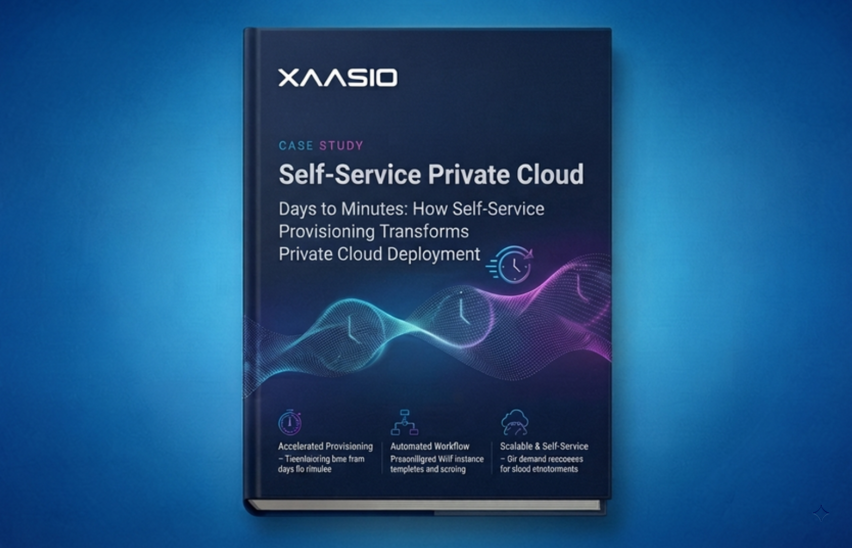
OpenStack remains the default XaasIO Compute platform


SPDX and CycloneDX outputs are available for every supported release

Frequently asked questions


What is XaasIO Compute?

XaasIO Compute is an OpenStack-based private cloud platform built on KVM. It provides self-service virtual machines, networks, images and persistent storage through a portal, APIs and infrastructure as code.

Is OpenStack the default platform for XaasIO Compute?

Yes. OpenStack is the standard and default cloud platform for XaasIO Compute. Other platforms are supported only through separately scoped Advanced Platform Support Packs.

Is OpenStack a hypervisor?

No. OpenStack is a cloud control platform that coordinates compute, networking, storage, images, identity and resource placement. KVM is the standard hypervisor used by XaasIO Compute.

What can users provision through XaasIO Compute?

Users can provision approved virtual machines, images, networks, routers, floating IP addresses, security groups, persistent volumes, snapshots and load balancers. Optional architectures can also provide GPUs and bare-metal servers.

Does XaasIO Compute support GPUs and high-performance workloads?

Yes, when the required hardware and software are included in the validated architecture. Available options can include dedicated CPUs, NUMA-aware placement, huge pages, SR-IOV, PCI passthrough, GPUs, vGPUs and bare-metal servers.

Can XaasIO Compute operate in an air-gapped environment?

Yes. XaasIO Compute can be designed with local repositories, identity, monitoring, logging and controlled update procedures for disconnected, sovereign and restricted environments.

What is the difference between XaasIO Compute and XaasIO Virtualization?

XaasIO Compute is cloud-first and designed for self-service, multi-tenancy, projects, quotas and APIs. XaasIO Virtualization is VM-first and designed for familiar host, cluster, storage and virtual-machine operations.

Are other XaasIO modules required?

No. XaasIO Compute can operate independently. XaasIO CMP, XaasIO MLT, XaasIO Hyperscaler Platform and the XaasIO data and AI platforms are optional add-ons.

Get in Touch with Our Architecture & Success Team

Evaluate a VMware Exit, scope a hyperscaler repatriation plan, or launch a managed OpenStack/Kubernetes/Data/AI platform.
We’ll propose a practical path to production with clear milestones and managed service options.